Coat of Arms Nigtevecht
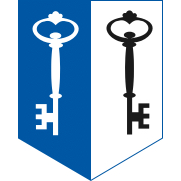
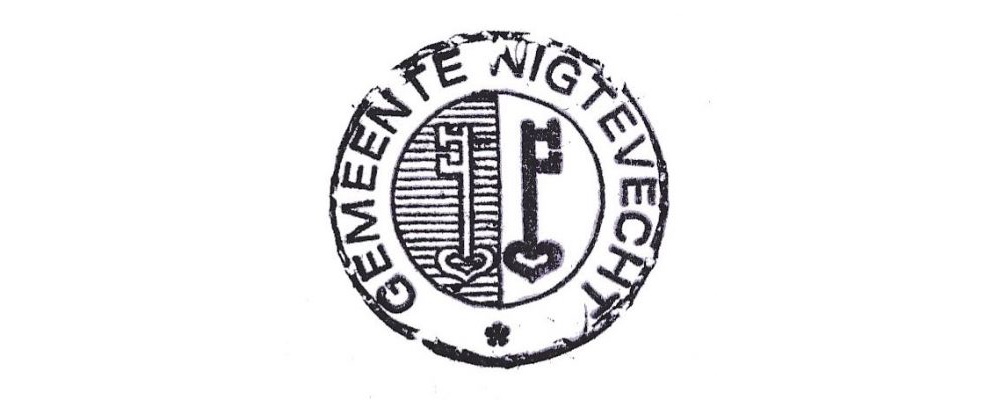
The Corporate Logo Branding of Powerful Signature is a variant of the ancient Coat of Arms of Nigtevecht, a former Dutch municipality, as a reference to my family name "van Nigtevecht". The inverted keys as Logo is out of respect of the Family Huydecoper Lord of Nigtevecht as their Coat of Arms.
In the 1990s, I saw an old drawing of the coat of arms with the keys pointing down, described as a very old version no longer in use. Whether true or not, I have since used this unconfirmed ancient version with "NIGTEVECHT" and keys pointing down, out of respect for the original design used by the family "Huydecoper, Lord of Nigtevecht" and the formerly royal acceptance of the municipality's coat of arms. The coat of arms fell out of use after a municipal merger in 1986.
The Coat of Arms Nigtevecht is still visible in stone above the door of the former town hall (Raadhuis) at Dorpsstraat 142 in Nigtevecht.
The following articles are some interesting and peculiar backgrounds about the Coat of Arms and family names, the history of the area. It is not an academic peer reviewed article, it is just the best I could find on the internet to follow up stories which I was told when I was young.
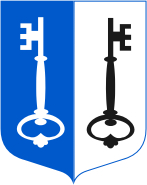
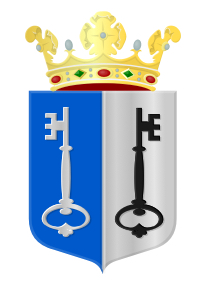
The Blue-white with Keys upwards is the Coat of Arms Nigtevecht, in Dutch "Wapen van Nigtevecht." The sample seen here is the original Coat of Arms which was for centuries in use as an added family weapon, to denote "lord of", within the coat of Arms of a nobility family. This was used for the Town Nigtevecht. It's use ended after local regions merged into a larger council area.
Based on what I found, in a still ongoing search, it seems that at first the Coat of Arms was given by the Bishops of Utrecht to the person who as Mayoral paid the taxes to the Bishops of Utrecht for the selling of peat to most likely Amsterdam. Most likely there was an early nobility family involved. I have not yet found a confirmed history of this, though I'm told there was one before certain power over the area was acquired by the Huydecoper family somewhere between 1200 and 1400.
"From the middle of the 12th century onwards the descendants of the mayors provided themselves with a second name, mostly referring to a location (Van Abcoude, Van Amstel, Van Loenersloot, Van Maarssen) "www.cambridge.org page 9 so this must have included "Van Nigtevecht" but is not recorded. Maybe the use of coloured flags was already in use as identifiers, then used as their banner when they claimed more authority.
At around 1500 it must have been a knighthood. It was the time of the Ministeriales which were originally unfree servicemen (dienstmannen) of the diocese of the Bishops of Utrecht, they acted as estate supervisors, military horsemen, and local entrepreneurs. The where serfs, had no freedom at all. Overtime they managed to tear down the chains gaining more freedom, and yet then lost it to greater powers.
Since there was no surname for non-nobility, it was a person with a first name who was then known with a functional name like "Cornelius the tax payer of Nigtevecht" as mayoral and later became a lower knighthood. The use became similar to within the nobility denoting names. Overtime it must have become a custom to use a name like "Cornelius of Nigtevecht", while the mayoral tasks disappeared. The name stuck, not "job title". There was also a bailiff controlling the area and someone who observed the work serfs had to complete. This must have merged somehow in a position of greater powers over the population. The mayoral function, bailiff an knighthood, passed on to the nobility somewhere between 1400 and 1600. It was by this time most likely a different nobility family after which it was acquired by the Huydecoper family.
After Spain lost control over the Dutch areas in the 1500's, the Bishops of Utrecht, subjected to the Spanish power and Rome, lost the rights to raise taxes in the northern areas. The powers over the areas above the river Rhine and to the West, became Princely and later the Royal powers (known as the 7 Provinces). Searches on the web gave confusing results, Even AI gave some mixed up results due to the name similarities and marriages within the same family having the same first-last names and titles. It took a bit of retrying and then a more likely result could be deducted based on articles found.
The origin of the Coat of Arms Nigtevecht goes back to the time of the "Bischops of Utrecht" which explains the position of the upwards keys. I saw in the 90's a document showing downward keys as an older format, but that document is lost and recent search showed nothing. It may have been an unreliable source. The origin of the coat of arms colours are not well documented. The may have existed as old flags, used by local powers, which then became the shields.
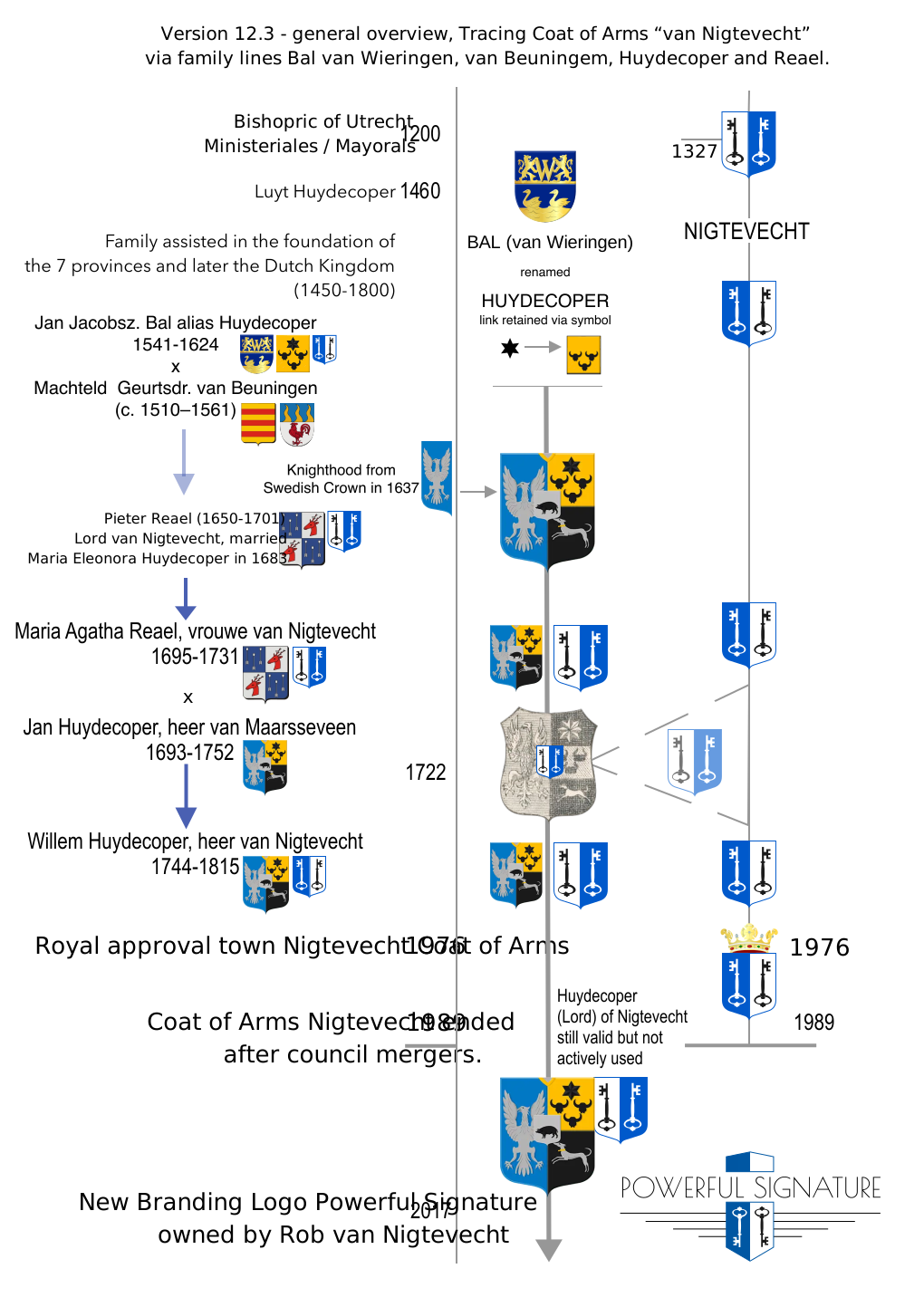
I made an overview of what overtime happened with the Coat of Arms Nigtevecht in connection with the Huydecoper famliy history. But I omit the detailed ancestry line as this is less relevant to tracing Coat of Arms. The overview, the whole article, is based on what I was able to find, and surely this is not complete or without error. If anyone know sources with information to improve this, then let me know.
Tracing more details
Each time I find more details I amend the overview. The timeline of my own family, all the way back to the 1500's seems partially lost, or is still in records no one checked. It does not help that most of the fathers were given the same first names and that records were kept in times when invaders burned down the town. We only know our origin was in the place Nigtevecht. The oldest traceable ancestor was from around 1620. The ones before this, 1500 to ~1620, are not documented on the web. There is no link to a possibility they used the coat of arms representing governing the local area as mayoral, but there still may have been a nobility acting on behalf of the Bishops of Utrecht.
Today the Huydecoper family has still the right to use the name "Huydecoper van Nigtevecht" but this seems for practical reasons not used as it denotes "Huydecoper Lord of Nigtevecht" while there is no active Lordship over the area of Nigtevecht. The Coat of Arms Nigtevecht is most likely still their privilege. The question is then if this is the white-blue format, or the blue-white. Maybe the knowledge is lost or not so relevant because after the early death of "Maria Agate Reael Hydecoper, woman of Nigtevecht", her husband married again. Today the coat of Arms has in the center "Lord of Maarsseveen".
"Huydecoper Lord van Nigtevecht" was a Lordship title (in Dutch: "Heerschap") and also a knightly title (Jonkheer, Young Lord). The later published title under the larger coat of arms reads: "The Liberties of Edw Huydecoper van Nigtevecht", rather than "The Liberties of Edw Huydecoper Lord of Nigtevecht", though this may be equivalent due to heraldic title usage.
Trace the origing of the title knighthood and then Lordship titles "van Nigtevecht" is difficult. After a lot a tracing I discovered that the tile "Nigtevecht" "looped" between two families, from Huydecoper to Reael, and back to Huydecoper.
In short I was able to get a reasonable overview based on parts found via Google AI.
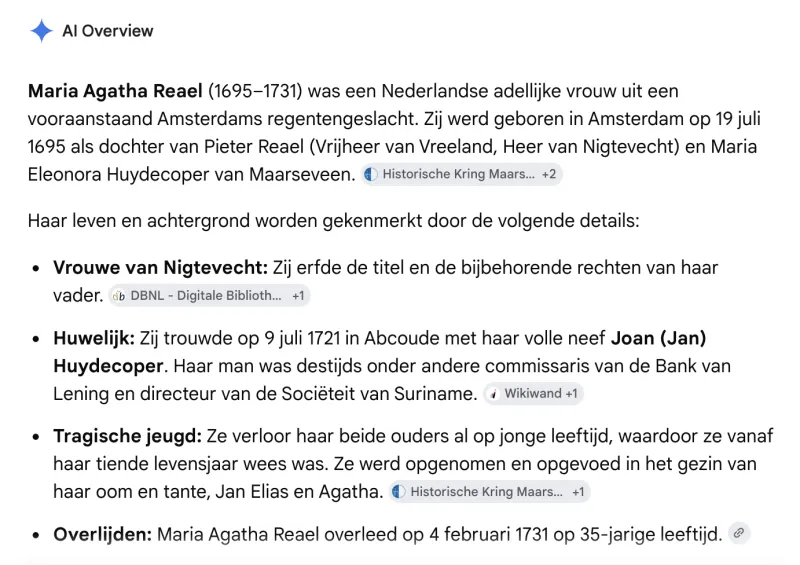
Pieter Reael, who was a grandnephew of Laurens Reael, stayed in the Netherlands, married into the Huydecoper family, and the became actual Lord of Nigtevecht. Pieter Reael married a daughter from the Huydecoper family in 1683, after which their own daughter returned the title of "Nigtevecht" in 1721 to the Huydecopers. Because Pieter Reael and Maria Huydecoper no male heirs transferred who retained the title, their daughter Maria Agatha inherited Reael the title "Lady of Nigtevecht" She married in 1721 with her cousin Jan Huydecoper. This led to the title (and the name) "Lord of Nigtevecht" finally in the Huydecoper family.
After this at some point the coat of arms was used in the Town on a building during the period the Huydecopers acquired greater powers over the area. It still does not resolve how the mayoral title, or later knighthood, "van Nigtevecht" ended up in the family Huydecoper somewhere after the 1500's. The actual acquisition of mayoral and knighthood title "van Nigtevecht" must have happened between 1500 and 1600, in the chaotic years when the Union of Utrecht emerged (1579). The noble title of Lord of Nigtevecht emerged later in the family as a Dutch knighthood.
Was the family long before 1500 associated with the area, did they act on behalf of the Bishop of Utrecht, then switched to the protestant side and gained higher titles as grant for assisting the Dutch Princedom under development? Or was it another family? Did the one who controlled the area under the powers of the Bishops of Utrecht vanish, causing an uncontrolled area which had to be managed again? Or was it taken forward by a noble family which disappeared? Was there a person known as "the mayoral, the knighthood van Nigtevecht", who maintained the ministeriales but lost no longer being a serf lost their work and title taken over by those who had the power to do this? We may never know, and the complete history of the Coat of Arms Nigtevecht is lost.
The colours blue-white can go back as far to the time of the Romans. The Romans used flags, maybe people took over the custom in their tribal areas. The keys must have been added later as is has most likely religious. The Roman Catholic power is "the descendant of the Old Roman Empire", they just continued in a different form. The Bishops of Utrecht may have send copies of their tax records and some other writings to the Vatican to fulfil their duties of reporting. "The name Nigtevecht first appears in history in an official document by Bishop Jan of Utrecht, dated October 7, 1327. In this text, Nigtevecht is called a bailiff's district (schoutambacht)" (vandereem.org )which shows there was already a power controlling the area. The ministeriales may have existed parallel of this.
It is logic that the function of "the mayoral of Nigtevecht" paying taxes to the Bishops of Utrecht ceased. But quickly the task of managing land and taxes must have ended up with an unknown person and then the Huydecoper's, after which it became a Lordship. The one who formerly raised the taxes, who was addressed as "someone from Nigtevecht" and just before 1500 seen as a knighthood, if existed, may have vanished. Things go easily lost in the mist of time.
The symbols of Coat of Arms
Left blue means "science and truth"
Right white or silver means "loyalty"
This is also according other sources a reference to water.
General meaning of the keys is "power to lock and unlock"
This expresses power over the faithful, derived from the religious origin of the Keys of Peter, but according to an official heraldic page it means "trust, silence, helpfulness". Other sources also suggest meanings such as "authority, stewardship, security, and the power to bind and unbind".
This Coat of Arms is a mayoral power, it was possibly linked to the lower nobility.
The keys pointing down, used for the site logo which is the ancient Coat if Arms, adds nuances like "humility, readiness for use, or a lower/base position". This could be the one before mayoral rights were incorporated in the shield. There is not much known about the ancient Coat of Arms withe the keys down. We just have to accept the keys up as the only verified one.
The Crown is a sign of dignity and Authority, the Royal approval, but no longer in use
According vandereem.org the name can also have originated from "Niftar", which became "Niftarlaka", meaning "along a lake or water-run", which was replaced with "Niftarvechta", said to mean "along the Vecht". The word "Laka" is interesting as it sound familiar to English and is not far from the English use. We find a similar sound when using "Nigh to the Vecht", near to a water-run". The district of Nigtevecht was as far back as before 1027 occupied by the Frisians. "The name Nigtevecht first appears in history in an official document by Bishop Jan of Utrecht, dated October 7, 1327" mentioned on the website.
The actual date when the Town was founded is unknown. Based on archaeological findings and Roman records, de area was occupied in Roman times by the Frisians, a Scandinavian group. Based on archaeological findings a church existed before 1200.
In old Dutch there were three variations of the name Nigtevecht, which was Niftervecht and Nichtevecht and Nigtevegt. They all mean "aan de Vecht" or "at the Vecht". It is a very old name of the river "Fecht". Nifter and Nigt has a broader meaning, like "near" or "bend" (Dutch "bocht"). Old Dutch and English share similarities; you can hear it in "Nigh" and "to the River Vecht", hence "nigh to the Vecht".
There was a Roman fort called Castellum Fectio at Vechten near Utrecht, built by Drusus between 12 BC and AD 39. At that time, the river branch with the Rhine ran through the centre of Utrecht. Dutch Archaeological PDFhas more details about Castella Fectio, later also called Feht or Fehtna. The website at cambridge.orggives more insight about the period between the Romans and the year 1200.
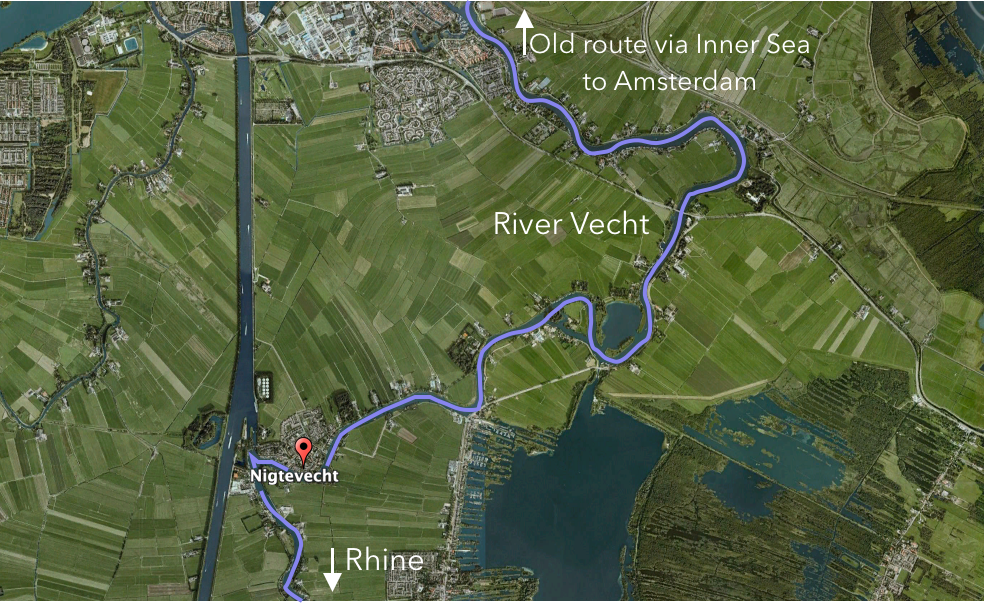
There is an unsolved matter if the Romans gave the river the name "Fechtio", later known as "Fecht" and then "Vecht", or they named the Roman Fort after the river already known among the Friesian locals as "the Fecht". This was a shallow river from the Rijn to the then occupied area by northern Friesians which around 1200 became "Zuiderzee", during a disastrous flood, which submerged most of Holland. Many people must have perished all the way from the areas above the Rhine to west and north Friesland. North Holland was once called west Friesland. The inner sea became a inner Lake, renamed Ijselmeer. In the image you see the meandering river Vecht from the Rhine to the northern area of Holland, the inner sea. The lake on the east side is the result of centuries of peat extractions.
This was a Frisian area long before the Romans, until around 600. After the great flood disaster of 1200 the river was recorded as the "Vecht". The language shares a commonality with Old English or Anglo-Frisian. The Frisii, as they were called, declined dramatically in the 4th century, but it was only until 1600 they completely disappeared in the west of Holland.
There is a possible wider and older link between the old Gaelic and Frisian. There are hills made in Gaelic times in the middle of Holland, around Hilversum, and in the north east megalith long graves which I think are wrongly called "hunnebeds". There are possibly linguistic links. The Frisians were hired by the Romans to fight along Hadrian Wall indicating that some Frisian words are "borrowed" from this time noticeable into the North East and Scotland. In Frisian the children are "de Bens", thought it is generally accepted that the word "the Bens" -- a Frisian word for children -- is from the Viking era, it can be a mix of continental Gaelics and Frisians, part of pre-Scandinavian cultures.
Before the Romans there n extensive trading activity existed during the times of the Gaelic or "Celtic" cultures, and the "Hallstadt" (which was at a high conjuncture at the time of Nebuchadnezzar, Daniel and Ezekiel found in the Bible, at the time Rome was founded). It is only thanks to the Romans and Greek that we know something about the ancient times of the Netherlands via their written records. It was a boggy, woody area, mainly good for fishing. The Frisians used oral traditions which cannot be trusted but may contain echo's of distant times, we can only rely on archaeological findings. Early church fathers described them as pagans worshipping many god having horrifying religious traditions. This cannot be relied on as they used hyperbolic language to defend their own beliefs against the others..
The name "Nigtevecht" originates at least from the time of the ministeriales"Reclamation of the peat lands" who as "mayorals" were part of the knighthood, a lower nobility between the 12th and 15th century, during which they served to manage the area on behalf of the Bishops of Utrecht, a Catholic power. It is assumed ot was first a Bailiff district, then it became Mayorals. "Mayorals" is not the same as "Mayor" being used today. The title, a lower nobility knighthood title, was linked to land management for marketing purposes, selling peat, paying taxes. The mayoral knighthood "van Nigtevecht" overtime became a Lordship, part of the higher nobility.
Many of the church records in the wider district were destroyed by invading armies or lost in fires. It did not help that Catholics from the south plundered the area and towns extensively. From the 1500's, especially the 1600's, the power to accept people into the nobility ended up with the Royals able to consolidate control over the area.
The town Nigtevecht is small. The French wrecked the village in Napoleonic wars. It regained its position in the wider area owned by nobility and royals, known as “the royal land jewel”. Peter the Great visited here. There were large houses and land owned by the nobility. According to the kerknigtevecht.nl website, there was a place called “Petersburg”, a princely “landjuweel” (Land Jewel) on the Vecht. The name was taken from Tsar Peter the Great, Emperor of Russia, who visited this area several times during his stay in 1717. The Lordship of Nigtevecht was a significant title being responsible as caretaker of this area, and represented one of the few very powerful families in Holland.
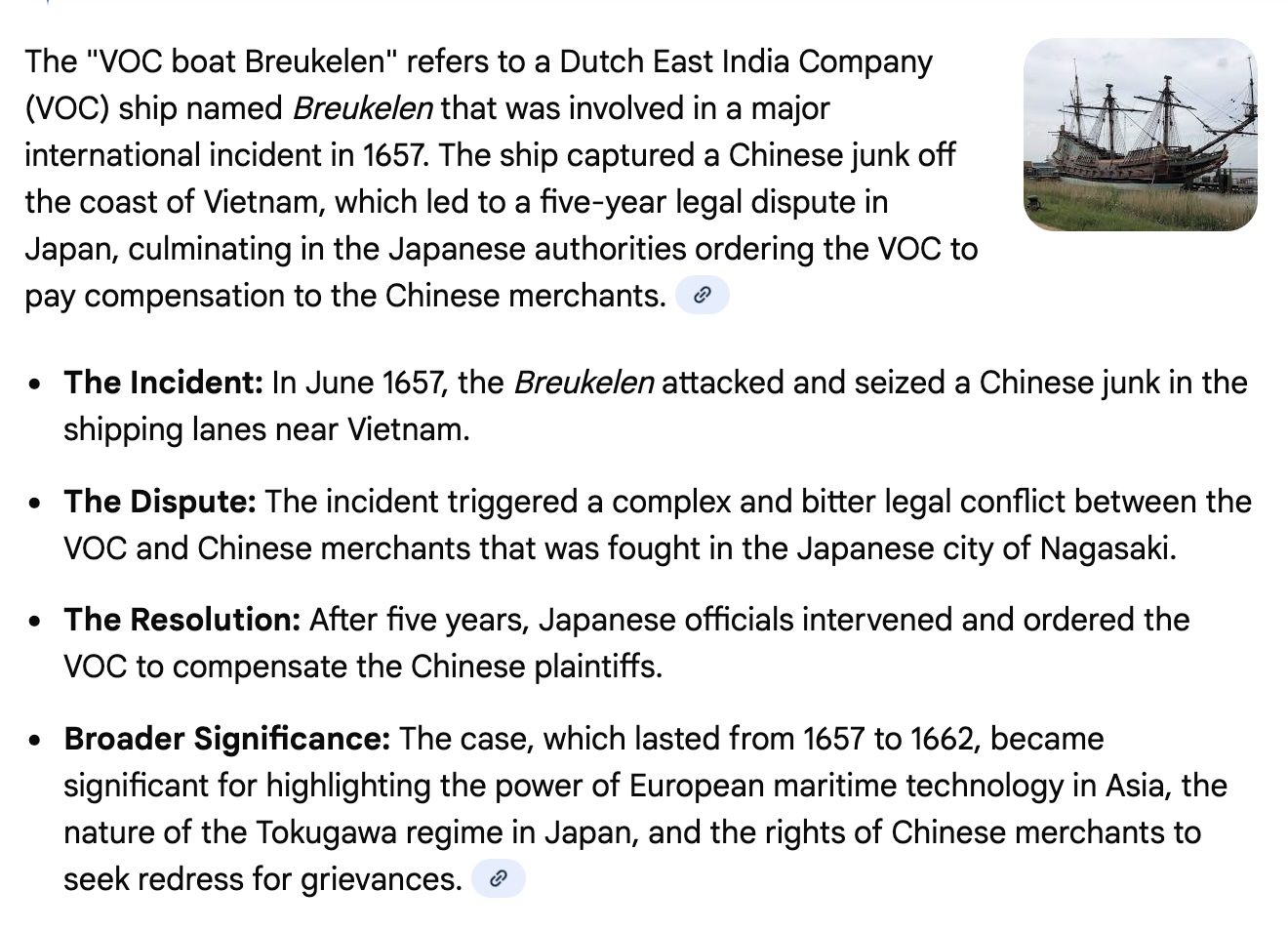
"Mayorals" took names like "van Breukelen", "van Maarsen" etc as mentioned in the article, and their descendants were part of the knighthood. They all had their own variation using flags and coat of arms. This is where the names and it's many variations, started.
My name comes from this place.

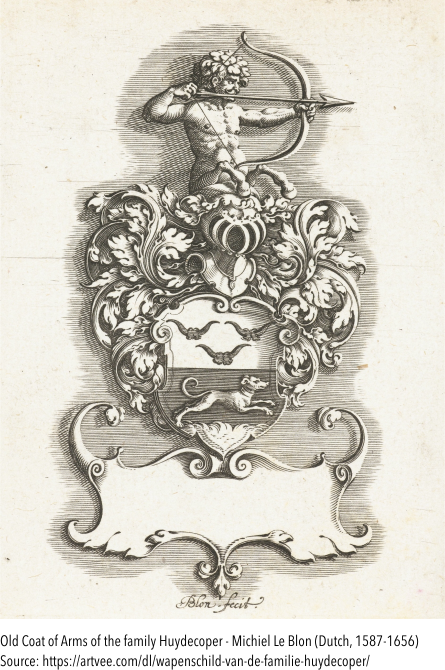
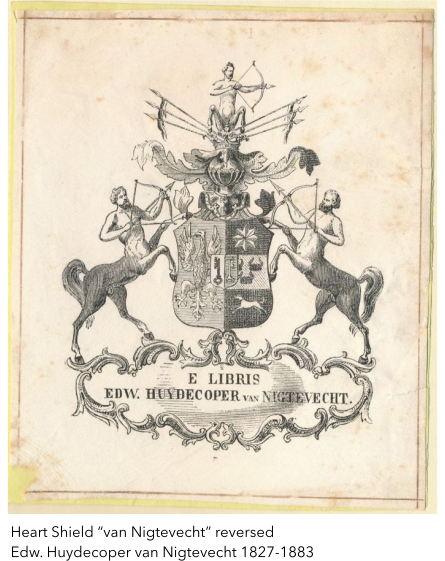
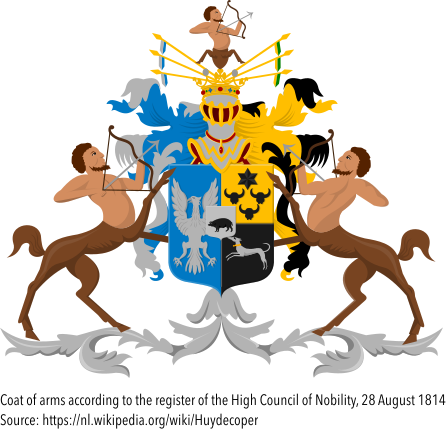
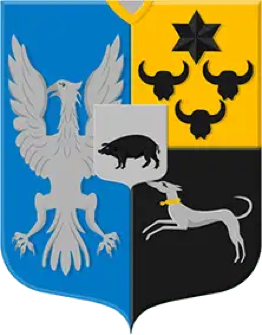
This is a sample of the Huydecoper family Coat of Arms ( source hallet.nl ) making a distinction between Huydecoper with a noble title like adding "Lord of Nigtevecht", and those without. In this case the heart shield is of the "Free Lord of Maarsseveen". Edward Huydecoper created a version with "Lord of Nigtevecht" as heart shield which was reversed due to the blue colour on the left, that version is not used. The Coat of Arms changed, for a short time the "heart shield" showed the Coat of Arms Nigtevecht and the right side was differently divided, in three panels. In the current Coat of Arms the heart shield is "Lord of Maarsenveen" and the right hand side divided two panels.
But with all the changes, the title Lord of Nigtevecht remains but is not used.
They were an Amsterdam mayoral and patrician family. Several members held administrative positions as directors of the Dutch East India Company (VOC) and Dutch West India Company (WIC), the admiralty, and the state. However, it began with extensive merchant activity, and the various in-laws all have a trading past. In 1814, Jan Willem Huydecoper was appointed to the Knighthood of Holland, and thus he and his descendants became members of the Dutch nobility."
Many within the Huydecoper family were merchants, bankers, lawyers, even consul and ambassador, they held at times held positions at the Dutch royal court, likely due to their wealth, power, and education as well as their nobility background. Records related to "the forgotten Anglo-Dutch War" mention "Jonkhheer Hudecoper van Nigtevecht" (a "Sir"). They also where closely linked by marriage to the Reael family, another well known powerful family in Amsterdam.
Within a noble family, the title was typically passed only to the eldest son. A similar inheritance must existed among ministeriales who became "mayoral" but as a custom, not an official name. The Family Huydecoper has many descendants who are from within the Nobility, even one from a British Nobility..
I was able to trace the name "van Nigtevecht" of my own family back to the early 1600's by the name of Claesz Jans Van Nigtevecht, but anything before this seems lost. For some reason there is also a missing link between my grandfathers and the family back to Claesz Jansz. There is a gap of almost 200 years, possible due to not yet found church records. This may be lost in religious and national wars in the area of Nigtevecht burning down everything.
Most of the van Nigtevecht family, by then commoners, lived at the time in Loosdrecht, Weesp, and Breukelen, and a few in Amsterdam, all close to the area of Nigtevecht itself. Note that "van" was used to mean "coming from". I think it will be extremely difficult, if not impossible, to trace the ancestor back who was a possible Mayoral of Nigtevecht between 1200 and 1500, using at that time the Coat of Arms Nigtevecht, and is genetically linked to our family branch. It also means I could have a Frisian ancestor who at the time lived in or around Nigtevecht. That part of the history is lost.
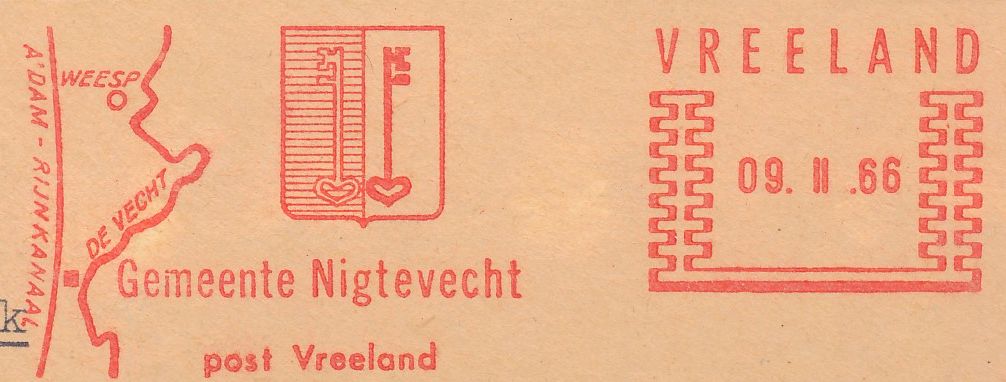
Post stamps with the coat of arms Nigtevecht
Yes they exist also, it was used by the post office of the village Nigtevecht, ( source heraldry-wiki )
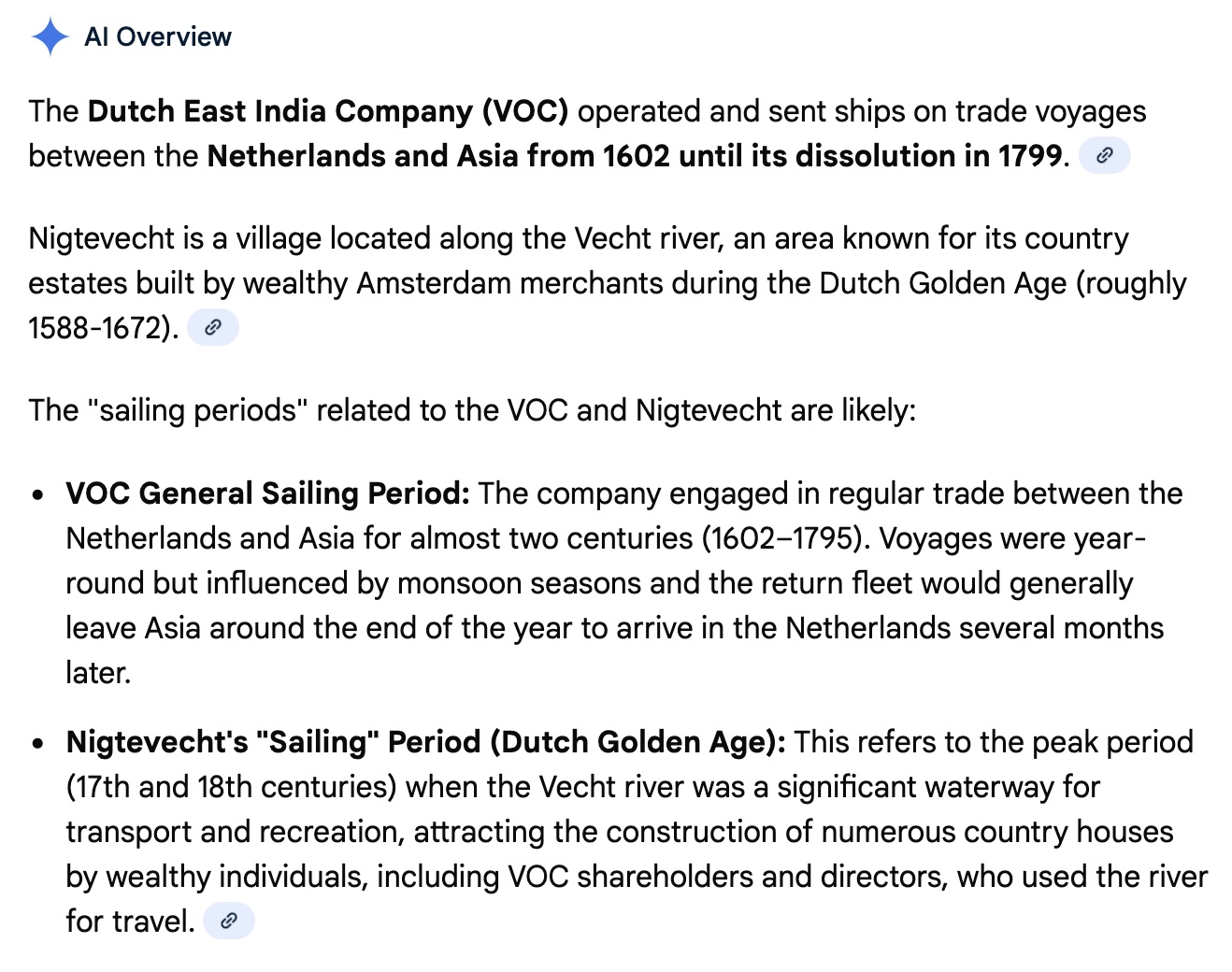
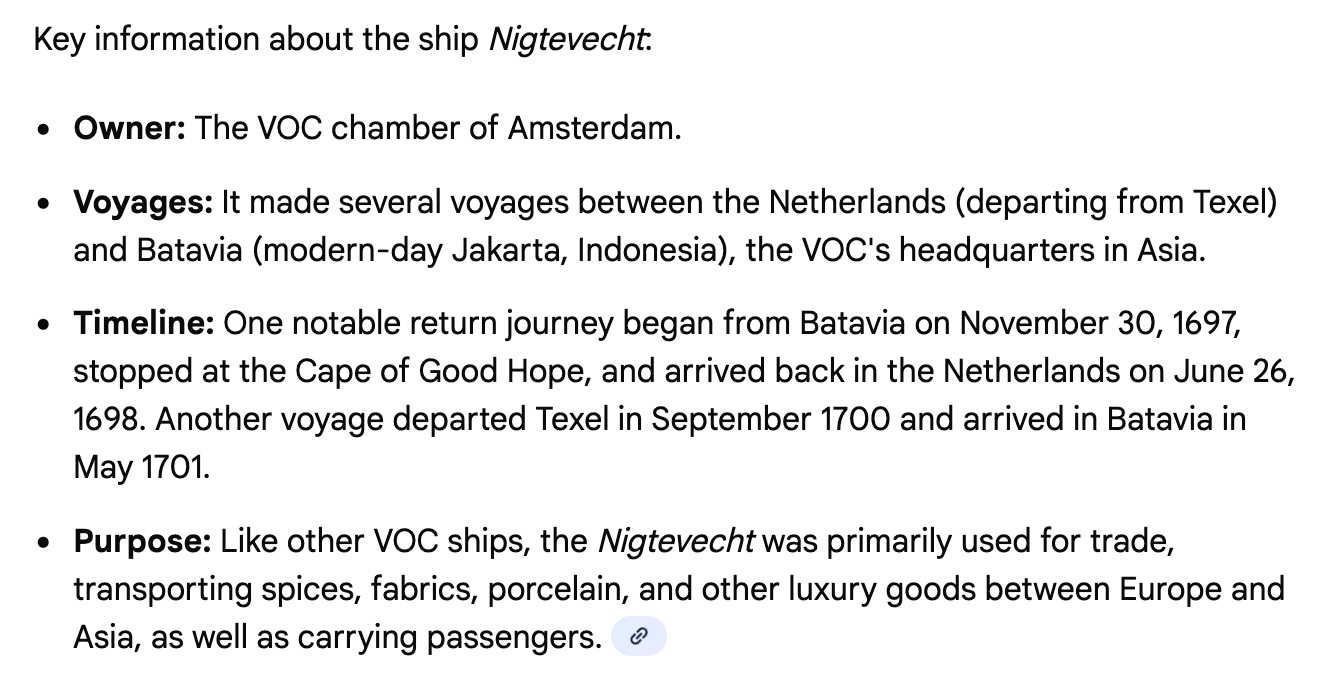
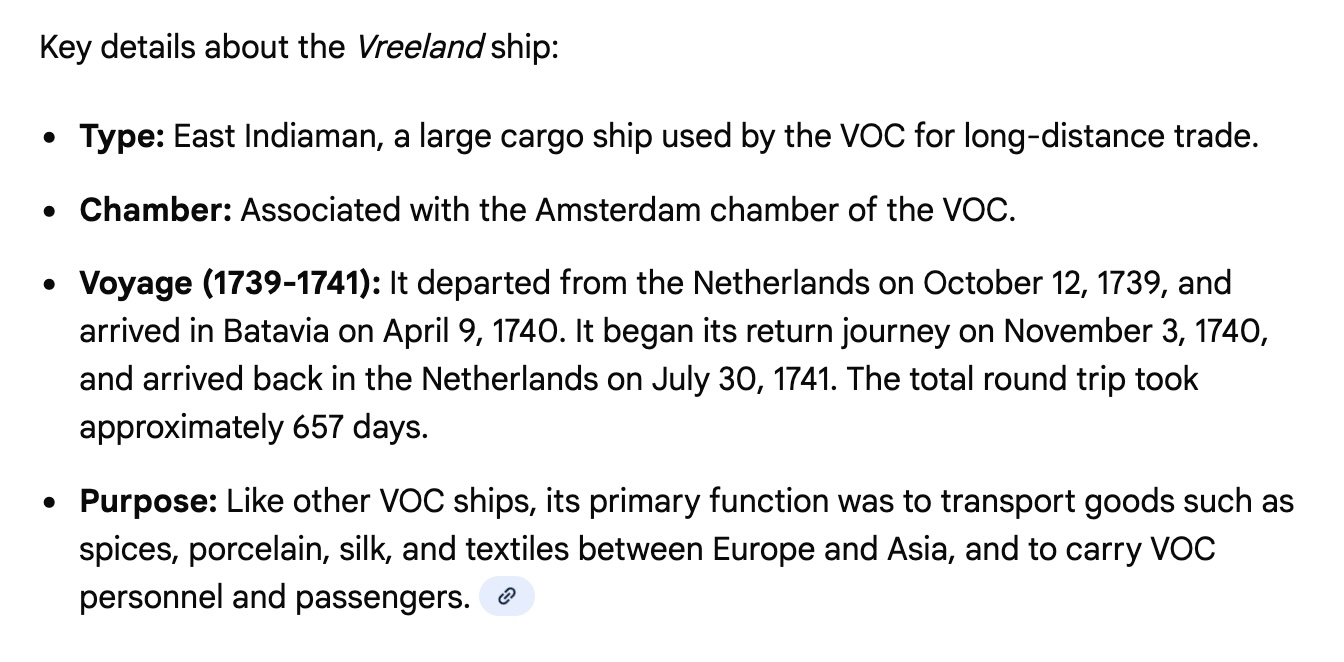
A ship named the Nigtevecht was a Dutch East India Company (VOC). Sadly, no old painting of this merchant vessel survives; it must have been very impressive.
They found an ancient log-boat from 700–600 BCE in Nigtevecht. A pre-Roman era shipwreck (log-boat) near the modern village has been catalogued under the name Nigtevecht. The merchants of the VOC had large houses and much land in the area of Nigtevecht, they represented the great wealth in Holland under control of a Republic, before the United Kingdom raised in power. Nevertheless, the House of Orange fully controlled the VOC. The VOC period was the era where also Prince William III became King of England.
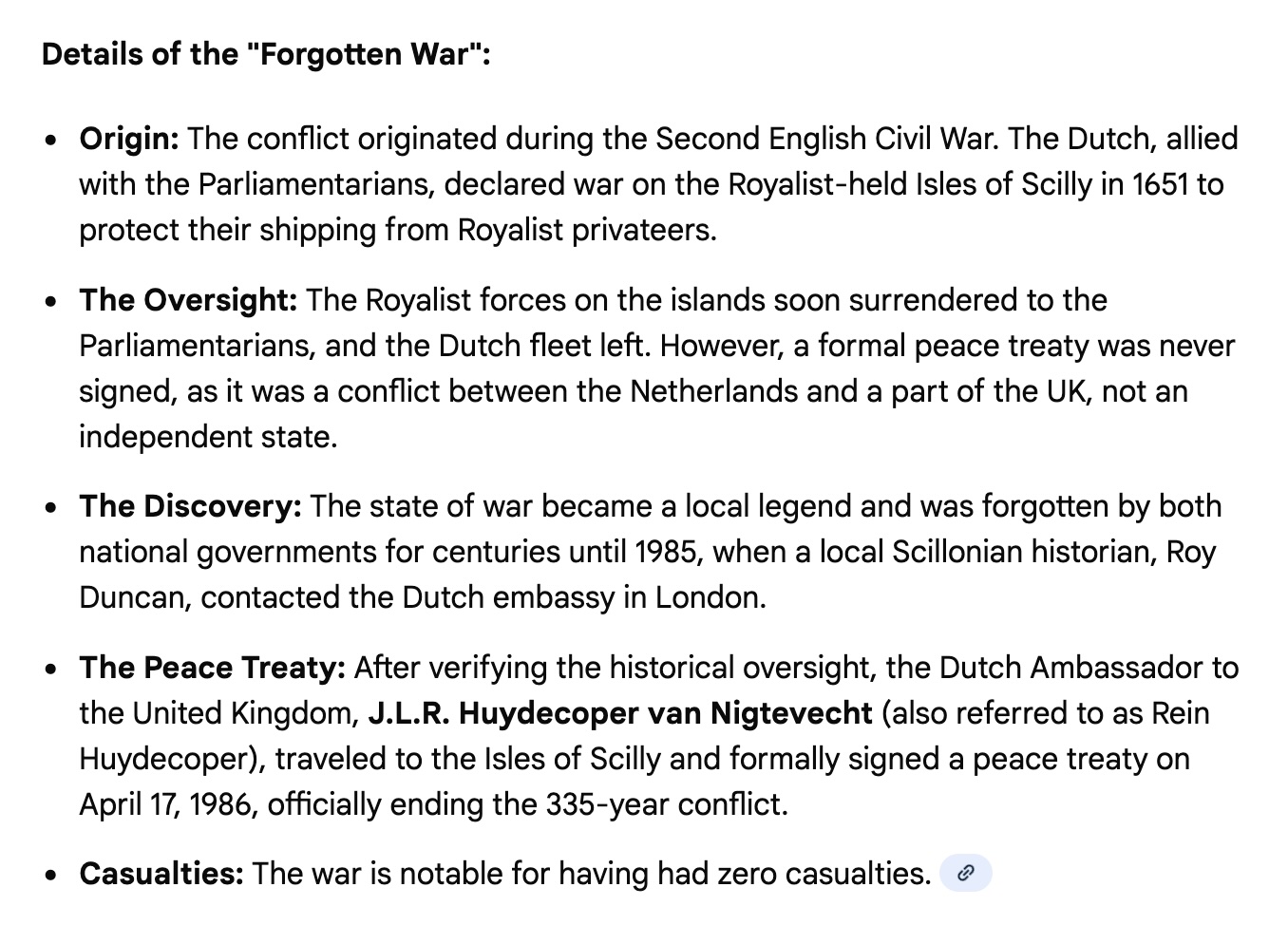
This is another curious history related to de "Huydecoper van Nigtevecht " family about a forgotten war, a page on ( vlagblog.nl -Scilly Isles )mentions the following.
In 1986, a symbolic peace treaty between the Isles of Scilly and the Netherlands was signed by Dutch ambassador Jonkheer Rein Huydecoper van Nigtevecht (signed without the old title). This event ended a 335-year conflict, formally declaring peace centuries after the last Anglo-Dutch War had concluded, though a formal peace had apparently been overlooked. There are many interesting articles about this was on britishonlinearchives.com about the "350 years treaty of westminster signed ending the third anglo dutch war" (1672–1674), and www.historic-uk.com.
"...While their hereditary title of Jonkheer (equivalent to Lord/Esquire) remains active within the official Dutch nobility, modern family members (such as the diplomat Jhr. Jan Louis Reinier Huydecoper van Nigtevecht in the late 20th century) deliberately chose not to use their titles in public or official diplomatic capacities..." (Google AI). They are still "Huydecoper van Nigtevecht" but no longer use this as such.
The war on Scilly Islands which started a bit later, was only signed as a peace treaty in 1986!
There is an explanation on the ( vlagblog.nl -Scilly Isles )website how they discovered the forgotten war in 1986 "Roy Duncan, historian and chairman of the Isles of Scilly Council, wrote to the Dutch embassy in London to dispel the myth that the archipelago was still at war with the Netherlands. The embassy investigated and concluded that the myth was indeed based on truth (Whitelocke's letter)."
The 335-year war ended with zero casualties, a unique achievement. The absence of any deaths may also explain why it was forgotten in a corner of Britain. There was no formal declaration of war, and the peace went unnoticed. England was in turmoil during the Cromwell period and had other priorities. I think "The Long Boring Forgotten Anglo-Dutch War" would be a more appropriate title!
There are more stories associated with the name Nigtevecht for which I have found no proof. One of these is that a naval vessel called "the Nigtevecht" ended up in the fleet of one of the Kings of England together with a vessel called "The Vreeland". I found old records of ships loaned from the Dutch to English kings but no evidence of this, nor of them being seized by the English. This must be incorrect anyway because VOC ships were merchant vessels, not naval ships. The VOC ships were around 1650 called Nigtevecht, Vreeland, and Breukelen around 1650; this information is easy to find, and linked to the Huydecoper and Reael families.
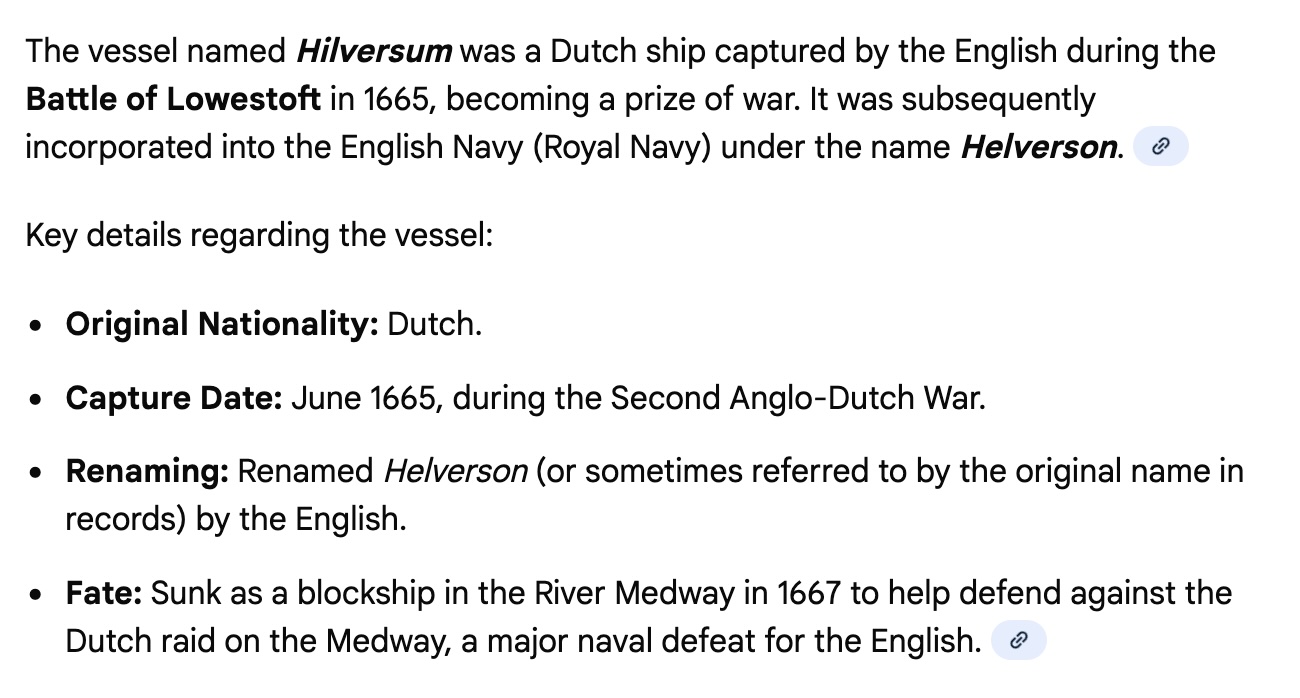
There was a vessel captured by the English Navy called "the Hilversum", which was then incorporated into the English Navy. Oddly, that bears the name of the place where I was born.
In the year 2000 I read a lot about the history of the "van Nigtevecht" family maintained by someone in Weesp with the same family name. The information on this personal website seems lost. I read a lot of details here with reference to archives no longer available on the web. It may be available within in old historical paper archives held by Dutch authorities and organisations. We have to remember that what's available on the web is only a small portion of all the historical documents. Much of the material can only be traced via extensive research visiting places and requesting copies, if allowed.
We think the internet can give us correct information, but this depends on what has been transferred from old paper archives, if not lost during conflicts. I discovered that even AI gives often the wrong information "reading" wrong, speculative or unverified documents. Converting all paper history is sheer impossible due to the enormous effort and excessive cost involved, but a lot has become available thanks to scanning and people's interest in genealogy.
The Logo's, product images, and webdesign made by Rob van Nigtevecht owener of Powerful Signature.
Occasionally I use a background image from Pexels, the free images are credit to the photographers.
© Copyright 1 Jan 2017
Powerful Signature
Rob van Nigtevecht
Trademark Logo's are owned by;
- QuareUp
- Drupal.org
this is Governed by United Kingdom Regulations.