

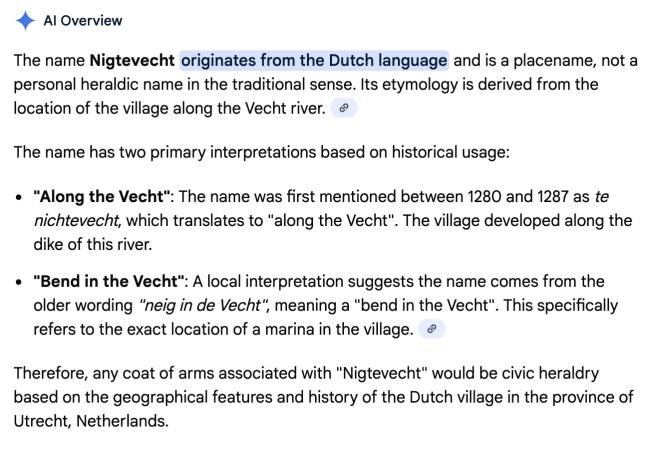
Old Dutch for Nigtevecht was Niftervecht, which seems to mean "aan de Vecht" or "at the Vecht". But Nifter has a broader meaning, like "near" or "bend" (Dutch "bocht"). Old Dutch and English share similarities; you can hear it in "nigh" and "to the River Vecht", hence "nigh to the Vecht". The town name dates back to 1281, when Count Willem IV of Holland granted Vecht farmers the right to dam the river and use the water to irrigate their land. There was a Roman fort called Castellum Fectio at Vechten near Utrecht, built by Drusus between 12 BC and AD 39. At that time, the river branch with the Rhine ran through the centre of Utrecht. The river seems either to have been named after Fectio or the Fort after the river or the Fort after the river. Dutch Archeological PDFhas more details about Castella Fectio, later called Feht or Fehtna. After the great flood disaster of 1200 the river was recorded as the Vecht. The area was Frisian from long before the Romans until around 600, the language shares a common ancestor known as Old English or Anglo-Frisian. This is also why Nigtevecht sounds so close to Nigh-to-the-Vecht. And in Frisian the children are "de Bens", Dutch "kerk", the Scottish "kirk". But some of the similar words are also introduced by Vikings during invasions. The Frisians were hired to fight along Hadrian Wall indicating that some Frisian words are "borrowed" from this time. Before this time there was also an extensive trading activity (the Gaelic or "celtic" cultures and the "Hallstadt" period which was at the time of Nebuchadnezzar, Daniel and Ezekiel, found in the Bible). It is only thanks to the Romans and Greek that we know something of this time via their written records. The northern cultures used oral traditions so we can only rely on archeological findings. A culture without writen records is easily lost in the mist of times.
The town Nigtevecht is small. The French wrecked the village. It regained its position in the wider area owned by nobility and royals, known as “the royal land jewel”. Peter the Great visited here. There were large houses and land owned by the nobility. According to the kerknigtevecht.nl website, there was a place called “Petersburg”, a princely “landjuweel” on the Vecht. The name was taken from Tsar Peter the Great, Emperor of Russia, who visited this area several times during his stay in 1717. The Lordship of Nigtevecht was a significant title being responsible to be the caretaker of this area.
It is possible that the name "van Nigtevecht" originates from the time of the ministeriales"Reclamation of the peat lands" who as mayors were part of the knighthood but not the nobility half way the 12th century, during which they served to manage the area. Mayors took names like "van Breukelen", "van Maarsen" etc as mentioned in the article, and their descendants were part of the knighthood. This is where the name "van Nigtevecht", and it's variations, may have started. My name comes from this place, but it is highly unlikely there is a direct link to the "Huydecoper van Nigtevecht" family, unless someone married into it and took the name "van Nigtevecht" via the male line. In that case, the female name should have been recorded as "van Nigtevecht Huydecoper", which I have not found anywhere. That said, registration among commoners was inconsistent and relied on church archives, many of which were destroyed by invading armies or lost in fires. It did not help that Catholics from the south and Protestants from the north of Holland plundered the town extensively.
It seems Google AI confuses things a bit—it would be wrong to rely fully on AI results when seaching on the family name histories. There are families with the full name “Huydecoper van Nigtevecht”, families named just “Huydecoper”, and families named “van Nigtevecht”, sometimes with variants like “Nichtevegt” or “Nigtevegt” after “van Nigtevecht” to indicate they may have used differently spelled names. It is even possible that a descendant “van Nigtevecht” has an ancestor named “van Nichtevegt” or “van Nigtevegt” while also one took it as an title based on their place in society.
Perhaps a few branches split off from the ministeriales who became mayors confusing the origins for others who also took the village name “van Nigtevecht” just as a name, which was very common.
Napoleon further complicated matters when he invaded Holland and forced people to adopt fixed surnames instead of descriptions like "Gerrit, son of the baker in Weesp, brother of the miller in Muiden". The name "van Nigtevecht" is linked to "Huydecoper" as a noble title; there is no record indicating otherwise. By the time Huydecoper took on the rsponsibilities for "Nigtevecht" as a Lord, the original descendants of the ministeriales who became mayors had already vanished.
Within a noble family, the title was typically passed only to the eldest son. A similar inheritance existed among ministeriales who became mayors. Some genealogy websites list the full surname as "Hudecoper van Nigtevecht" even for those not part of the nobility, while others were. Some are recorded simply as "Huydecoper" even when linked to the noble family. Only a few carried the lordship or "Sir" title. The Family Huydecoper has many decendants who are form within the Nobility, even one from Britain.
This is a sample of the Huydecoper family at ( source hallet.nl ) making a distinction between Huydecoper with a nobel title like adding "Lord of Nigtevecht", and those without. "They are an Amsterdam mayoral and patrician family. Several members held administrative positions as directors of the Dutch East India Company (VOC) and Dutch West India Company (WIC), the admiralty, and the state. However, it began with extensive merchant activity, and the various in-laws all have a trading past. In 1814, Jan Willem Huydecoper was appointed to the Knighthood of Holland, and thus he and his descendants became members of the Dutch nobility." Interestingly, they used blue on the left side on their Coat of Arms.
The name Nigtevecht became part of Huydecoper through the lordship of Nigtevecht. Within the Huydecoper family, many were merchants, bankers, lawyers, even a consul, and at times held positions at the Dutch royal court, likely due to their wealth, power, and education. Records related to "the forgotten Anglo-Dutch War" mention "Jonkhheer Hudecoper van Nigtevecht", which is more akin to "Sir" than "Lord".
I was able to trace the name "van Nigtevecht" back to the early 1600's by the name of Claesz Jans Van Nigtevecht, found at ( source genealogy.com ). But for some reason there is a missing link between my great-great-grandfather and the family back to Claesz Jansz. There is a gap of almost 200 years. This may be due to birth and burial records not yet found, or lost in religious and national wars, perhaps also in accidental church fires.
Most of the van Nigtevecht family lived at the time in Loosdrecht, Weesp, and Breukelen, and a few in Amsterdam, all close to the area of Nigtevecht itself. Note that "van" was used to mean "coming from". It is quite possible that different families with the name "van Nigtevecht" exist but are not genetically related.